Zhengzhou Protech
Home > News

Product

Contact Us

Leave Message

Contact Us

All products are customizable, leave message immediately, we will reply as soon as possible.

Name

Tel/WhatsApp

E-mail *

Country *

Raw Materia

Message *

Verification code *

I can't see clearly, refresh

Cemented Carbide Full Production Process: Vacuum Furnace Sintering + CVD Coating Collaborative Solution

For your custom heating needs, reach us here:
Against the backdrop of industrial upgrading for high-end cutting tools, molds, and mine wear-resistant components, process collaboration between vacuum furnace sintering and CVD coating serves as the core determinant of cemented carbide compact density, metallographic structure, and surface wear and corrosion resistance. The optimized integrated process significantly reduces porosity and enhances coating adhesion, emerging as the mainstream technical route for high-volume production of premium cemented carbide in 2026.zvFMuffle Furnace,Tube Furnace,Vacuum Furnace,Atmosphere Furnac
zvFMuffle Furnace,Tube Furnace,Vacuum Furnace,Atmosphere Furnac
1. Overall Process Logic of Cemented Carbide: Sintering for Substrate, Coating for Performance EnhancementzvFMuffle Furnace,Tube Furnace,Vacuum Furnace,Atmosphere Furnac
zvFMuffle Furnace,Tube Furnace,Vacuum Furnace,Atmosphere Furnac
Finished cemented carbide performance depends on substrates and surface coatings. Vacuum sintering guarantees substrate mechanical properties, while CVD coating achieves surface functional enhancement. The core technical difficulties lie in parameter matching, cleanliness control and thermal stress management. The complete production workflow covers powder batching, molding, vacuum low-pressure sintering, surface pretreatment and CVD coating, among which sintering and coating are decisive for product comprehensive performance.zvFMuffle Furnace,Tube Furnace,Vacuum Furnace,Atmosphere Furnac
zvFMuffle Furnace,Tube Furnace,Vacuum Furnace,Atmosphere Furnac
Mismatched process parameters between sintering and coating commonly cause porosity, unbalanced carbon content and coating peeling in carbide products. This solution adopts precise sintering, carbon balance control and stress relief principles to optimize the whole process, delivering high-quality carbide with strong interfacial bonding and fewer defects.
zvFMuffle Furnace,Tube Furnace,Vacuum Furnace,Atmosphere Furnac
 
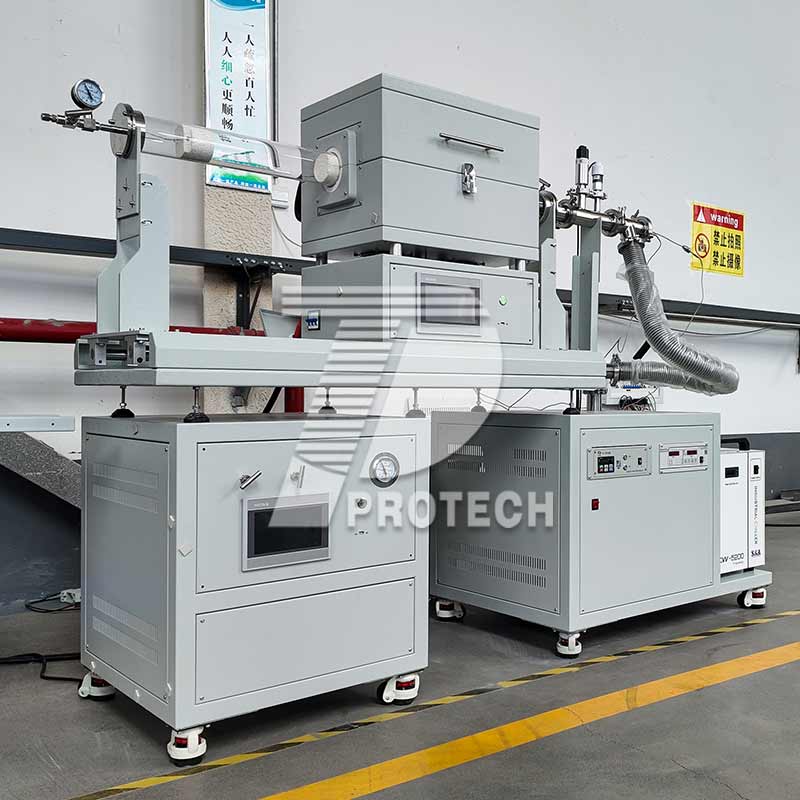
cvd tube furnace
zvFMuffle Furnace,Tube Furnace,Vacuum Furnace,Atmosphere Furnac
2. Vacuum Furnace Sintering: Core Forming Process for Cemented Carbide SubstrateszvFMuffle Furnace,Tube Furnace,Vacuum Furnace,Atmosphere Furnac
zvFMuffle Furnace,Tube Furnace,Vacuum Furnace,Atmosphere Furnac
Vacuum sintering is the key to manufacturing qualified cemented carbide substrates, with core control objectives including low porosity, precise carbon content, uniform metallographic structure, and low residual stress, providing high-quality blanks for subsequent CVD coating procedures.zvFMuffle Furnace,Tube Furnace,Vacuum Furnace,Atmosphere Furnac
zvFMuffle Furnace,Tube Furnace,Vacuum Furnace,Atmosphere Furnac
2.1 Equipment Structure and Working Principle of Vacuum Sintering FurnaceszvFMuffle Furnace,Tube Furnace,Vacuum Furnace,Atmosphere Furnac
Specialized vacuum sintering furnaces for cemented carbide consist of a vacuum unit, graphite heating system, multi-stage atmosphere regulation module, and water-cooled temperature control system. The equipment removes forming agents and impurity gases under high vacuum conditions and completes degreasing, dewaxing, and liquid-phase sintering through gradient heating. Inert atmosphere suppresses WC oxidation to ensure blank purity.zvFMuffle Furnace,Tube Furnace,Vacuum Furnace,Atmosphere Furnac
zvFMuffle Furnace,Tube Furnace,Vacuum Furnace,Atmosphere Furnac
2.2 Key Parameter Control for Sintering ProcesseszvFMuffle Furnace,Tube Furnace,Vacuum Furnace,Atmosphere Furnac
Sintering parameters directly determine substrate quality. The optimal industrial process range covers a sintering temperature of 1380℃~1450℃, vacuum degree ≤ 1Pa, and holding time of 60~180 minutes. Precise carbon control is critical: excessive carbon leads to graphite inclusion, while insufficient carbon generates brittle η-phase, both resulting in coating peeling and tool chipping in subsequent applications.zvFMuffle Furnace,Tube Furnace,Vacuum Furnace,Atmosphere Furnac
zvFMuffle Furnace,Tube Furnace,Vacuum Furnace,Atmosphere Furnac
2.3 Technical Advantages and Upgrading Directions of Low-Pressure SinteringzvFMuffle Furnace,Tube Furnace,Vacuum Furnace,Atmosphere Furnac
Compared with conventional atmospheric sintering, vacuum low-pressure sintering reduces internal porosity to below 0.02% and restrains abnormal grain growth through micro-positive pressure argon to refine WC grain structure. In 2026, mainstream upgrading directions include AI segmented temperature control, circulating gas purification, and automatic air pressure compensation to accommodate mass production of ultra-fine grain cemented carbide.zvFMuffle Furnace,Tube Furnace,Vacuum Furnace,Atmosphere Furnac
zvFMuffle Furnace,Tube Furnace,Vacuum Furnace,Atmosphere Furnac
2.4 Substrate Pretreatment after Sintering (Key Preparation for CVD Coating)zvFMuffle Furnace,Tube Furnace,Vacuum Furnace,Atmosphere Furnac
Sintered blanks cannot be coated directly and must undergo passivation, polishing, degreasing, and high-temperature dehydrogenation. These procedures eliminate free surface carbon, oxide layers, and internal residual gases to guarantee uniform substrate roughness, preventing pinholes, bubbles, and poor adhesion in CVD coatings.
zvFMuffle Furnace,Tube Furnace,Vacuum Furnace,Atmosphere Furnac
3. CVD Coating Technology: Surface Functional Enhancement for Cemented CarbidezvFMuffle Furnace,Tube Furnace,Vacuum Furnace,Atmosphere Furnac
zvFMuffle Furnace,Tube Furnace,Vacuum Furnace,Atmosphere Furnac
CVD chemical vapor deposition forms rigid ceramic coatings via high-temperature gas-phase reactions,effectively improving surface hardness, high-temperature resistance, and friction corrosion resistance while compensating for the poor high-temperature oxidation resistance of carbide substrates.zvFMuffle Furnace,Tube Furnace,Vacuum Furnace,Atmosphere Furnac
zvFMuffle Furnace,Tube Furnace,Vacuum Furnace,Atmosphere Furnac
3.1 Equipment and Deposition Principle of CVD CoatingzvFMuffle Furnace,Tube Furnace,Vacuum Furnace,Atmosphere Furnac
Dedicated CVD coating furnaces for cemented carbide adopt graphite reaction chambers. Process gases such as TiCl₄, AlCl₃, N₂, and CH₄ are introduced to undergo gas-phase chemical reactions at 900℃~1050℃, depositing multi-layer composite coatings including TiC, TiN, and Al₂O₃ on the substrate surface. The equipment requires a high-purity chamber, precise gas flow control, and uniform temperature distribution.zvFMuffle Furnace,Tube Furnace,Vacuum Furnace,Atmosphere Furnac
zvFMuffle Furnace,Tube Furnace,Vacuum Furnace,Atmosphere Furnac
3.2 Mainstream Coating Systems and Application ScenarioszvFMuffle Furnace,Tube Furnace,Vacuum Furnace,Atmosphere Furnac
The universally adopted industrial composite structure consists of a TiN bottom layer, TiCN transition layer, and Al₂O₃ heat-resistant layer, balancing adhesion, wear resistance, and thermal insulation performance. Golden TiN is suitable for general cutting, while dark gray Al₂O₃ adapts to high-temperature dry cutting. Multi-layer composite coatings can extend tool service life by 3 to 8 times.zvFMuffle Furnace,Tube Furnace,Vacuum Furnace,Atmosphere Furnac
zvFMuffle Furnace,Tube Furnace,Vacuum Furnace,Atmosphere Furnac
3.3 Core Control Difficulties of CVD ProcesseszvFMuffle Furnace,Tube Furnace,Vacuum Furnace,Atmosphere Furnac
High-temperature deposition easily induces thermal stress, Co phase precipitation, and decarbonization defects on carbide substrates. Temperature fluctuation, gas impurities, and uneven airflow are the three major causes of coating defects. Therefore, CVD parameters must be customized to match sintered substrates instead of adopting universal process curves.
zvFMuffle Furnace,Tube Furnace,Vacuum Furnace,Atmosphere Furnac
4. Collaborative Solution of Vacuum Sintering and CVD Coating (Core Chapter)zvFMuffle Furnace,Tube Furnace,Vacuum Furnace,Atmosphere Furnac
zvFMuffle Furnace,Tube Furnace,Vacuum Furnace,Atmosphere Furnac
Sintering and coating are independent yet interconnected procedures. The essence of collaborative optimization lies in unified carbon balance, matched thermal expansion coefficients, controlled interfacial bonding stress, and synchronized cleanliness standards, realizing integrated high-quality forming of substrates and coatings.zvFMuffle Furnace,Tube Furnace,Vacuum Furnace,Atmosphere Furnac
zvFMuffle Furnace,Tube Furnace,Vacuum Furnace,Atmosphere Furnac
4.1 Collaboration Principle 1: Unified Carbon Content ControlzvFMuffle Furnace,Tube Furnace,Vacuum Furnace,Atmosphere Furnac
The vacuum sintering stage maintains saturated carbon content to avoid η-phase generation. Low-temperature carbon balance annealing is implemented before CVD coating to eliminate residual sintering stress and prevent substrate decarbonization during high-temperature coating, ensuring brittle-free interfacial layers.zvFMuffle Furnace,Tube Furnace,Vacuum Furnace,Atmosphere Furnac
zvFMuffle Furnace,Tube Furnace,Vacuum Furnace,Atmosphere Furnac
4.2 Collaboration Principle 2: Gradient Matching of Temperature CurveszvFMuffle Furnace,Tube Furnace,Vacuum Furnace,Atmosphere Furnac
The sintering cooling rate is controlled at 3~5℃/min to avoid lattice distortion. CVD adopts stepped heating and slow cooling modes to narrow the thermal expansion difference between the substrate and coating and prevent coating cracking and edge peeling.zvFMuffle Furnace,Tube Furnace,Vacuum Furnace,Atmosphere Furnac
zvFMuffle Furnace,Tube Furnace,Vacuum Furnace,Atmosphere Furnac
4.3 Collaboration Principle 3: Closed-Loop Clean Atmosphere ManagementzvFMuffle Furnace,Tube Furnace,Vacuum Furnace,Atmosphere Furnac
Sintering and CVD furnaces share a high-purity gas purification system to strictly limit moisture and oxygen impurities. Vacuum sealed transportation is applied after sintering to isolate air oxidation, ensuring no oxide film or contaminants on the substrate before coating.zvFMuffle Furnace,Tube Furnace,Vacuum Furnace,Atmosphere Furnac
zvFMuffle Furnace,Tube Furnace,Vacuum Furnace,Atmosphere Furnac
4.4 Complete Implementation Process of the Collaborative SolutionzvFMuffle Furnace,Tube Furnace,Vacuum Furnace,Atmosphere Furnac
1. Sintering Stage: Segmented heating degreasing → High-vacuum sintering → Low-pressure densification → Gradient cooling → Carbon content detection;zvFMuffle Furnace,Tube Furnace,Vacuum Furnace,Atmosphere Furnac
2. Intermediate Treatment: Precision grinding → Ultrasonic degreasing → Vacuum dehydrogenation → Surface activation;zvFMuffle Furnace,Tube Furnace,Vacuum Furnace,Atmosphere Furnac
3. Coating Stage: Low-temperature preheating → Multi-layer alternating deposition → Atmosphere annealing → Stress relief;zvFMuffle Furnace,Tube Furnace,Vacuum Furnace,Atmosphere Furnac
4. Finished Product Inspection: Metallographic analysis, coating thickness detection, scratch adhesion testing, hardness and wear resistance testing.zvFMuffle Furnace,Tube Furnace,Vacuum Furnace,Atmosphere Furnac
zvFMuffle Furnace,Tube Furnace,Vacuum Furnace,Atmosphere Furnac
4.5 Performance Improvement Data of the Collaborative SolutionzvFMuffle Furnace,Tube Furnace,Vacuum Furnace,Atmosphere Furnac
After adopting the integrated sintering and CVD coating solution, the blank porosity of cemented carbide is controlled below 0.01%, coating adhesion is improved by 25%, the high-temperature oxidation resistance temperature reaches 1100℃, the continuous cutting life of tools is increased by 40%~70%, and the defective rate is reduced to less than 1.2%.
zvFMuffle Furnace,Tube Furnace,Vacuum Furnace,Atmosphere Furnac
5. Defect Optimization and 2026 Industrial Technical TrendszvFMuffle Furnace,Tube Furnace,Vacuum Furnace,Atmosphere Furnac
zvFMuffle Furnace,Tube Furnace,Vacuum Furnace,Atmosphere Furnac
Most carbide defects are caused by disjointed sintering and coating processes. Targeted parameter optimization can solve common quality issues: segmented pressure sintering inhibits coarse grains; vacuum dehydrogenation and gas purification eliminate coating pinholes and peeling; consistent cooling gradients and low-temperature annealing prevent stress cracking and edge chipping.zvFMuffle Furnace,Tube Furnace,Vacuum Furnace,Atmosphere Furnac
zvFMuffle Furnace,Tube Furnace,Vacuum Furnace,Atmosphere Furnac
In 2026, the cemented carbide industry will pursue ultra-fine grains, composite coatings and intelligent production. Advanced vacuum sintering furnaces adopt digital twin for precise automatic control. Combined CVD and MTCVD technology develops high-performance composite coatings. Seamless connection of production equipment further reduces production costs and defective rates.
zvFMuffle Furnace,Tube Furnace,Vacuum Furnace,Atmosphere Furnac
6. ConclusionzvFMuffle Furnace,Tube Furnace,Vacuum Furnace,Atmosphere Furnac
In summary, vacuum furnace sintering defines the lower performance limit of carbide substrates, while CVD coating elevates the application ceiling, and process collaboration acts as the core method for high-quality mass production. Through carbon balance management, temperature curve matching, closed-loop atmosphere purification, and intelligent parameter regulation, low-porosity, high-adhesion, and high-wear-resistance cemented carbide products can be manufactured. With the intelligent upgrading of thermal processing equipment, the integrated sintering and coating solution will become the standard process for manufacturers of high-end cutting tools, precision molds, and mine wear-resistant parts.zvFMuffle Furnace,Tube Furnace,Vacuum Furnace,Atmosphere Furnac
zvFMuffle Furnace,Tube Furnace,Vacuum Furnace,Atmosphere Furnac
Zhengzhou Protech Technology Co.,LTD is a professional manufacturer specializing in tube furnaces, muffle furnaces, atmosphere furnaces, and vacuum furnaces. We are committed to providing targeted solutions to meet your diverse heating equipment needs.zvFMuffle Furnace,Tube Furnace,Vacuum Furnace,Atmosphere Furnac
For customized heating solutions tailored to your specific requirements, feel free to get in touch with us:zvFMuffle Furnace,Tube Furnace,Vacuum Furnace,Atmosphere Furnac
WhatsApp: +86 17719806024zvFMuffle Furnace,Tube Furnace,Vacuum Furnace,Atmosphere Furnac
Email: info@lab-furnace.com
zvFMuffle Furnace,Tube Furnace,Vacuum Furnace,Atmosphere Furnac