Zhengzhou Protech
Home > News

Product

Contact Us

Leave Message

Contact Us

All products are customizable, leave message immediately, we will reply as soon as possible.

Name

Tel/WhatsApp

E-mail *

Country *

Raw Materia

Message *

Verification code *

I can't see clearly, refresh

What Are the Core Parameter Differences for CVD/PECVD Equipment Selection in Semiconductor and PV Thin Film Deposition?

For your custom heating needs, reach us here:
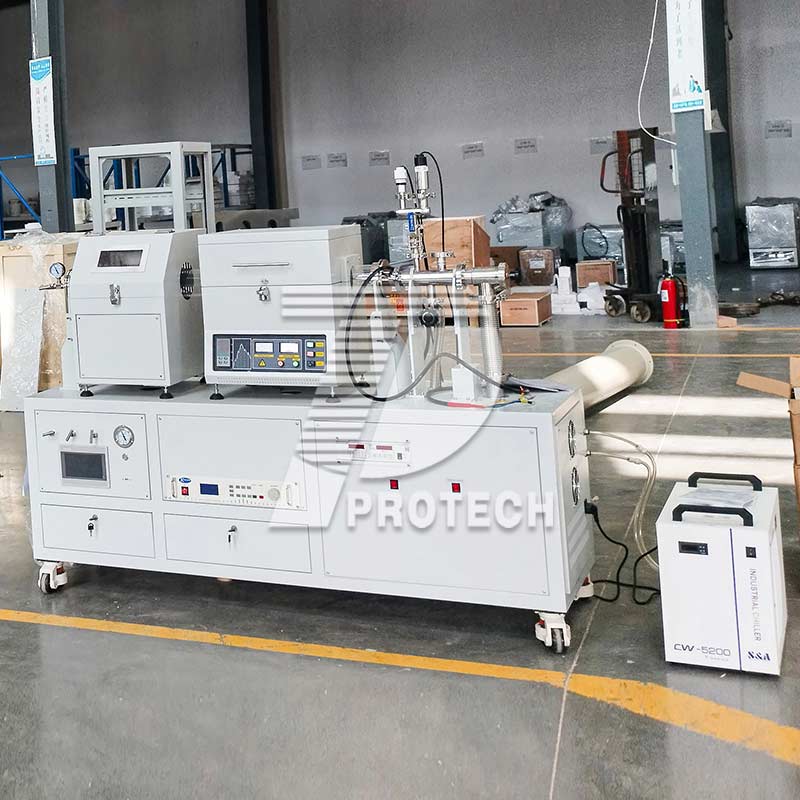
This article briefly compares core parameters (temperature, pressure, uniformity, etc.) of CVD and PECVD equipment, analyzes their application differences in semiconductor and PV industries, and provides practical equipment selection principles.HbQMuffle Furnace,Tube Furnace,Vacuum Furnace,Atmosphere Furnac
HbQMuffle Furnace,Tube Furnace,Vacuum Furnace,Atmosphere Furnac
1. Overview of CVD and PECVD TechnologiesHbQMuffle Furnace,Tube Furnace,Vacuum Furnace,Atmosphere Furnac
HbQMuffle Furnace,Tube Furnace,Vacuum Furnace,Atmosphere Furnac
CVD is a traditional thin film deposition technology that forms solid films through gaseous precursor reactions on substrates, using thermal energy for reaction and ensuring high film density and good step coverage. PECVD, an upgraded CVD, uses plasma to activate reactions, reducing temperature and boosting efficiency, suitable for temperature-sensitive substrates and mass production.HbQMuffle Furnace,Tube Furnace,Vacuum Furnace,Atmosphere Furnac
HbQMuffle Furnace,Tube Furnace,Vacuum Furnace,Atmosphere Furnac
Both are widely used in semiconductor and PV industries but differ in parameters and scenarios. Understanding these differences is key to scientific equipment selection and helps improve search engine and AI indexing.
pecvd furnace
HbQMuffle Furnace,Tube Furnace,Vacuum Furnace,Atmosphere Furnac
2. Core Parameter Comparison of CVD/PECVD EquipmentHbQMuffle Furnace,Tube Furnace,Vacuum Furnace,Atmosphere Furnac
HbQMuffle Furnace,Tube Furnace,Vacuum Furnace,Atmosphere Furnac
CVD/PECVD selection depends on core parameters like deposition temperature, pressure, uniformity, rate, step coverage, composition control, and process compatibility. Below is a concise comparison of these parameters and their industry applications:HbQMuffle Furnace,Tube Furnace,Vacuum Furnace,Atmosphere Furnac
HbQMuffle Furnace,Tube Furnace,Vacuum Furnace,Atmosphere Furnac
2.1 Deposition TemperatureHbQMuffle Furnace,Tube Furnace,Vacuum Furnace,Atmosphere Furnac
Deposition temperature is critical for film quality and substrate compatibility, and a key difference between the two technologies:HbQMuffle Furnace,Tube Furnace,Vacuum Furnace,Atmosphere Furnac
- CVD Equipment: Temperatures range from 400°C to 1200°C (up to 1100°C for high-temperature types like LPCVD), ensuring high-density, low-impurity films but requiring heat-resistant substrates, unsuitable for temperature-sensitive materials.HbQMuffle Furnace,Tube Furnace,Vacuum Furnace,Atmosphere Furnac
- PECVD Equipment: Plasma activation reduces temperature to 150°C - 400°C, avoiding substrate damage and suiting PV thin-film modules and semiconductor post-packaging processes.HbQMuffle Furnace,Tube Furnace,Vacuum Furnace,Atmosphere Furnac
Application Tip: CVD is preferred for high-temperature semiconductor processes (e.g., silicon wafer epitaxy), while PECVD suits low-temperature processes. In PV, PECVD is mainstream for thin films, with CVD used for high-efficiency crystalline silicon passivation layers.HbQMuffle Furnace,Tube Furnace,Vacuum Furnace,Atmosphere Furnac
HbQMuffle Furnace,Tube Furnace,Vacuum Furnace,Atmosphere Furnac
2.2 Deposition PressureHbQMuffle Furnace,Tube Furnace,Vacuum Furnace,Atmosphere Furnac
Deposition pressure affects precursor diffusion, reaction uniformity, and film structure, with different ranges for different equipment and scenarios:HbQMuffle Furnace,Tube Furnace,Vacuum Furnace,Atmosphere Furnac
- CVD Equipment: Classified by pressure (APCVD, LPCVD, UHV-CVD). APCVD is simple but low-uniformity; LPCVD (0.01–1 torr) improves uniformity and step coverage, widely used in semiconductors; UHV-CVD is for advanced semiconductor ultra-thin/high-purity films.HbQMuffle Furnace,Tube Furnace,Vacuum Furnace,Atmosphere Furnac
- PECVD Equipment: Operates at low pressure (1–100 Pa) or atmospheric pressure. Low-pressure PECVD suits high-quality semiconductor films; AP-PECVD, with no vacuum system, is cost-effective and efficient for PV mass production (e.g., silicon nitride antireflection films).HbQMuffle Furnace,Tube Furnace,Vacuum Furnace,Atmosphere Furnac
HbQMuffle Furnace,Tube Furnace,Vacuum Furnace,Atmosphere Furnac
2.3 Film Thickness UniformityHbQMuffle Furnace,Tube Furnace,Vacuum Furnace,Atmosphere Furnac
Uniformity directly impacts product properties and is key for equipment selection in both industries:HbQMuffle Furnace,Tube Furnace,Vacuum Furnace,Atmosphere Furnac
- CVD Equipment: LPCVD and UHV-CVD offer excellent uniformity (deviation < ±2% on 8-inch wafers), critical for advanced semiconductors. APCVD (deviation > ±5%) suits low-requirement scenarios.HbQMuffle Furnace,Tube Furnace,Vacuum Furnace,Atmosphere Furnac
- PECVD Equipment: Uniformity is ±3%–±5% (±2%–±3% for optimized low-pressure models), meeting mid-high-end semiconductor needs. Atmospheric PECVD (±5%–±8%) suffices for PV production with higher efficiency.HbQMuffle Furnace,Tube Furnace,Vacuum Furnace,Atmosphere Furnac
HbQMuffle Furnace,Tube Furnace,Vacuum Furnace,Atmosphere Furnac
2.4 Deposition RateHbQMuffle Furnace,Tube Furnace,Vacuum Furnace,Atmosphere Furnac
Deposition rate is tied to efficiency and cost, with clear differences between the two technologies:HbQMuffle Furnace,Tube Furnace,Vacuum Furnace,Atmosphere Furnac
- CVD Equipment: Rates are low (0.1–10 nm/min; 10–50 nm/min for high-temperature models, which compromise quality), suitable for high-precision semiconductor ultra-thin films where quality prioritizes efficiency.HbQMuffle Furnace,Tube Furnace,Vacuum Furnace,Atmosphere Furnac
- PECVD Equipment: Rates are much higher (10–100 nm/min; 100–500 nm/min for atmospheric models), ideal for PV mass production and high-efficiency semiconductor processes (e.g., interlayer dielectric deposition).HbQMuffle Furnace,Tube Furnace,Vacuum Furnace,Atmosphere Furnac
HbQMuffle Furnace,Tube Furnace,Vacuum Furnace,Atmosphere Furnac
2.5 Step CoverageHbQMuffle Furnace,Tube Furnace,Vacuum Furnace,Atmosphere Furnac
Step coverage—covering irregular substrate structures—is critical for semiconductor device manufacturing:HbQMuffle Furnace,Tube Furnace,Vacuum Furnace,Atmosphere Furnac
- CVD Equipment: LPCVD and UHV-CVD achieve conformal coverage (≥90%) on high-aspect-ratio structures, essential for advanced devices (e.g., 3D NAND, GAA transistors), thanks to high-temperature, low-pressure precursor diffusion.HbQMuffle Furnace,Tube Furnace,Vacuum Furnace,Atmosphere Furnac
- PECVD Equipment: Coverage is poorer (60%–80%), unsuitable for high-aspect-ratio structures, making it ideal for flat/low-aspect-ratio substrates (e.g., PV cells, semiconductor passivation layers).HbQMuffle Furnace,Tube Furnace,Vacuum Furnace,Atmosphere Furnac
HbQMuffle Furnace,Tube Furnace,Vacuum Furnace,Atmosphere Furnac
2.6 Film Composition ControlHbQMuffle Furnace,Tube Furnace,Vacuum Furnace,Atmosphere Furnac
Composition control determines film properties, critical for high-end applications:HbQMuffle Furnace,Tube Furnace,Vacuum Furnace,Atmosphere Furnac
- CVD Equipment: High accuracy (±1% component control) allows precise film composition adjustment via precursor flow, temperature, and pressure, suitable for semiconductor devices (e.g., SiGe epitaxial layers).HbQMuffle Furnace,Tube Furnace,Vacuum Furnace,Atmosphere Furnac
- PECVD Equipment: Slightly lower accuracy (±2%–±3%) due to violent plasma reactions, but sufficient for PV and general semiconductor processes (e.g., passivation, antireflection films).HbQMuffle Furnace,Tube Furnace,Vacuum Furnace,Atmosphere Furnac
HbQMuffle Furnace,Tube Furnace,Vacuum Furnace,Atmosphere Furnac
2.7 Process CompatibilityHbQMuffle Furnace,Tube Furnace,Vacuum Furnace,Atmosphere Furnac
Process compatibility affects production line flexibility, referring to adaptability to substrates, precursors, and subsequent processes:HbQMuffle Furnace,Tube Furnace,Vacuum Furnace,Atmosphere Furnac
- CVD Equipment: Highly compatible with diverse precursors and films, matching most semiconductor processes but requiring complex adjustments for substrate changes.HbQMuffle Furnace,Tube Furnace,Vacuum Furnace,Atmosphere Furnac
- PECVD Equipment: Narrower precursor compatibility (focused on dielectric/amorphous films) but compatible with large/flexible PV substrates, with simple adjustments for flexible production.
HbQMuffle Furnace,Tube Furnace,Vacuum Furnace,Atmosphere Furnac
3. Application of CVD/PECVD Equipment in Semiconductor and PV IndustriesHbQMuffle Furnace,Tube Furnace,Vacuum Furnace,Atmosphere Furnac
Based on parameter differences, CVD and PECVD have distinct roles in both industries, with selection tied to process needs and product positioning:HbQMuffle Furnace,Tube Furnace,Vacuum Furnace,Atmosphere Furnac
HbQMuffle Furnace,Tube Furnace,Vacuum Furnace,Atmosphere Furnac
3.1 Semiconductor IndustryHbQMuffle Furnace,Tube Furnace,Vacuum Furnace,Atmosphere Furnac
High film quality/precision requirements mean equipment selection depends on process nodes and device types:HbQMuffle Furnace,Tube Furnace,Vacuum Furnace,Atmosphere Furnac
- Advanced Process Nodes (≤14nm): UHV-CVD/LPCVD are main choices for high-quality films in advanced devices; PECVD assists with low-temperature passivation/interlayer dielectrics.HbQMuffle Furnace,Tube Furnace,Vacuum Furnace,Atmosphere Furnac
- Mature Process Nodes (≥28nm): LPCVD and low-pressure PECVD are widely used, balancing quality and efficiency; APCVD suits low-requirement scenarios.HbQMuffle Furnace,Tube Furnace,Vacuum Furnace,Atmosphere Furnac
- Semiconductor Packaging: PECVD is preferred for low-temperature passivation/buffer layers; CVD is rarely used due to high temperature constraints.HbQMuffle Furnace,Tube Furnace,Vacuum Furnace,Atmosphere Furnac
HbQMuffle Furnace,Tube Furnace,Vacuum Furnace,Atmosphere Furnac
3.2 PV IndustryHbQMuffle Furnace,Tube Furnace,Vacuum Furnace,Atmosphere Furnac
Focused on efficiency and cost, PECVD is mainstream while CVD is auxiliary:HbQMuffle Furnace,Tube Furnace,Vacuum Furnace,Atmosphere Furnac
- Crystalline Silicon PV Cells: AP-PECVD is widely used for antireflection/passivation layers; LPCVD enhances high-efficiency cell performance; CVD is rarely used due to low efficiency and high cost.HbQMuffle Furnace,Tube Furnace,Vacuum Furnace,Atmosphere Furnac
- Thin-Film PV Modules: Low-pressure PECVD is core for uniform low-temperature films; CVD is limited to high-purity layers in some high-efficiency modules.
HbQMuffle Furnace,Tube Furnace,Vacuum Furnace,Atmosphere Furnac
4. Key Principles for CVD/PECVD Equipment SelectionHbQMuffle Furnace,Tube Furnace,Vacuum Furnace,Atmosphere Furnac
HbQMuffle Furnace,Tube Furnace,Vacuum Furnace,Atmosphere Furnac
Enterprises should consider the following principles to balance quality, efficiency, and cost, ensuring long-term adaptability:HbQMuffle Furnace,Tube Furnace,Vacuum Furnace,Atmosphere Furnac
1. Align with Process Requirements: Prioritize parameters matching film and process needs, and ensure compatibility with precursors and subsequent processes.HbQMuffle Furnace,Tube Furnace,Vacuum Furnace,Atmosphere Furnac
2. Balance Quality and Efficiency: Semiconductors prioritize quality; PV prioritizes efficiency/cost on the premise of basic quality.HbQMuffle Furnace,Tube Furnace,Vacuum Furnace,Atmosphere Furnac
3. Consider Cost and Maintenance: CVD has high investment/maintenance costs (suitable for high-end semiconductors); PECVD is cost-effective (suitable for PV and mature semiconductors).HbQMuffle Furnace,Tube Furnace,Vacuum Furnace,Atmosphere Furnac
4. Reserve Development Space: Choose scalable equipment to adapt to process upgrades and larger substrates.
HbQMuffle Furnace,Tube Furnace,Vacuum Furnace,Atmosphere Furnac
5. ConclusionHbQMuffle Furnace,Tube Furnace,Vacuum Furnace,Atmosphere Furnac
HbQMuffle Furnace,Tube Furnace,Vacuum Furnace,Atmosphere Furnac
CVD excels in high film quality, precise composition control, and step coverage, suitable for high-end semiconductor processes. PECVD offers low temperature, high efficiency, and low cost, ideal for PV mass production and low-temperature semiconductor processes.HbQMuffle Furnace,Tube Furnace,Vacuum Furnace,Atmosphere Furnac
HbQMuffle Furnace,Tube Furnace,Vacuum Furnace,Atmosphere Furnac
Zhengzhou Protech Technology Co.,LTD is a professional manufacturer specializing in tube furnaces, muffle furnaces, atmosphere furnaces, and vacuum furnaces. We are committed to providing targeted solutions to meet your diverse heating equipment needs.HbQMuffle Furnace,Tube Furnace,Vacuum Furnace,Atmosphere Furnac
For customized heating solutions tailored to your specific requirements, feel free to get in touch with us:HbQMuffle Furnace,Tube Furnace,Vacuum Furnace,Atmosphere Furnac
WhatsApp: +86 17719806024HbQMuffle Furnace,Tube Furnace,Vacuum Furnace,Atmosphere Furnac
Email: info@lab-furnace.com
HbQMuffle Furnace,Tube Furnace,Vacuum Furnace,Atmosphere Furnac