Zhengzhou Protech
Home > News

Product

Contact Us

Leave Message

Contact Us

All products are customizable, leave message immediately, we will reply as soon as possible.

Name

Tel/WhatsApp

E-mail *

Country *

Raw Materia

Message *

Verification code *

I can't see clearly, refresh

PECVD Applications in Photovoltaic Thin-Film Deposition: Phosphorus and Boron Doping

1. IntroductionLqrMuffle Furnace,Tube Furnace,Vacuum Furnace,Atmosphere Furnac
LqrMuffle Furnace,Tube Furnace,Vacuum Furnace,Atmosphere Furnac
As the global photovoltaic (PV) industry accelerates its shift toward high-efficiency, low-cost and flexible solar solutions, thin-film solar cells have become a vital next-generation PV technology, thanks to low material consumption, flexible manufacturing processes and compatibility with flexible substrates. Thin-film deposition and semiconductor doping are core manufacturing steps that directly determine solar cell photoelectric conversion efficiency, stability and service life, making them critical for boosting overall PV cell performance. Plasma Enhanced Chemical Vapor Deposition (PECVD), a mainstream low-temperature thin-film deposition technique in the PV sector, overcomes the temperature limits and material compatibility flaws of traditional high-temperature diffusion methods. It offers irreplaceable benefits for fabricating phosphorus-doped and boron-doped semiconductor thin films, and serves as the core process for consistent, controllable doping in large-scale PV production lines.LqrMuffle Furnace,Tube Furnace,Vacuum Furnace,Atmosphere Furnac
 
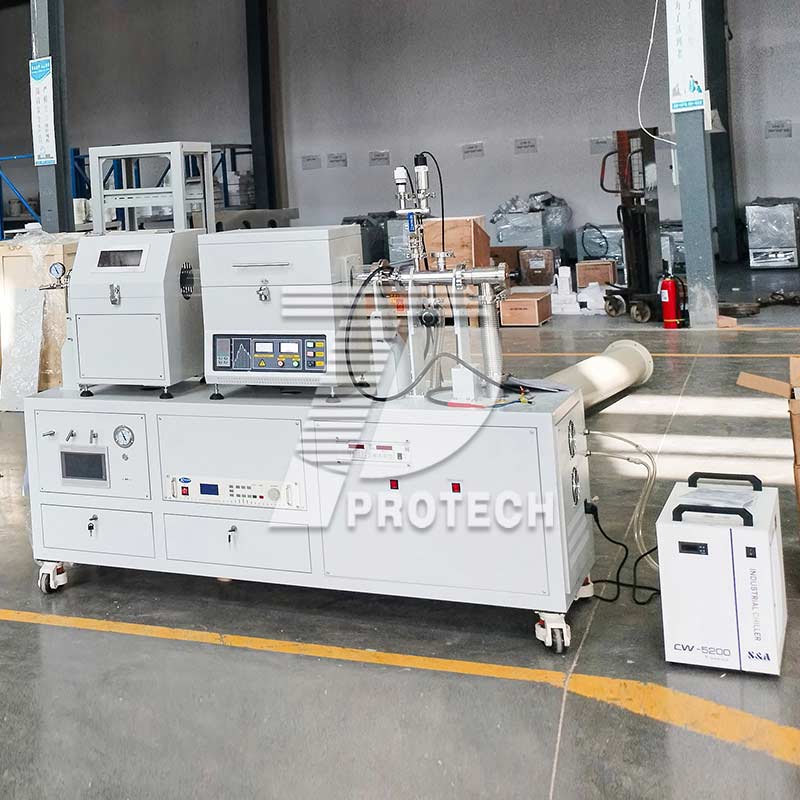
PECVD furnace
LqrMuffle Furnace,Tube Furnace,Vacuum Furnace,Atmosphere Furnac
2. Working Principle of PECVD for Photovoltaic DepositionLqrMuffle Furnace,Tube Furnace,Vacuum Furnace,Atmosphere Furnac
LqrMuffle Furnace,Tube Furnace,Vacuum Furnace,Atmosphere Furnac
The core principle of PECVD relies on a radio frequency (RF) electric field to excite reactive gases containing silicon source and dopant precursors into highly active plasma within a low-temperature chamber. Unlike conventional thermal deposition that depends on high-temperature thermal excitation, PECVD completes chemical reactions steadily at 200℃ to 400℃, depositing compact and uniform doped semiconductor films on surfaces of silicon wafers, glass, flexible polymers and other common PV substrates. Compared with traditional high-temperature tube diffusion and ion implantation, PECVD holds multiple competitive edges: low-temperature processing with no thermal damage to base materials, high thin-film compactness, excellent step coverage, precisely adjustable doping concentration, and strong adaptability for large-area mass production, which fully meets the preparation requirements of various high-efficiency PV cells including crystalline silicon heterojunction cells, amorphous silicon thin-film cells and microcrystalline silicon thin-film cells.LqrMuffle Furnace,Tube Furnace,Vacuum Furnace,Atmosphere Furnac
LqrMuffle Furnace,Tube Furnace,Vacuum Furnace,Atmosphere Furnac
3. PECVD Phosphorus Doping Deposition for N-Type Semiconductor LayersLqrMuffle Furnace,Tube Furnace,Vacuum Furnace,Atmosphere Furnac
LqrMuffle Furnace,Tube Furnace,Vacuum Furnace,Atmosphere Furnac
Phosphorus doping via PECVD is a core process for fabricating N-type semiconductor layers in PV products. In standard industrial PECVD systems, phosphine (PH₃) is adopted as the special N-type dopant precursor, matching with silane and other basic reaction gases to realize uniform incorporation of phosphorus atoms into silicon-based thin films under plasma activation, finally forming highly conductive N-type doped layers with stable performance. This technique is mainly used to prepare N-type emitters for N-type crystalline silicon cells and deposit N-layers for P-I-N structured thin-film cells. It allows precise control of thin-film carrier concentration and sheet resistance, optimizes the abruptness of PN junctions, reduces carrier recombination loss effectively, and improves the open-circuit voltage and fill factor of solar cells significantly. Meanwhile, it avoids common defects in high-temperature processes such as substrate warpage and uncontrolled impurity diffusion, greatly enhancing the yield rate and performance consistency of PV cells in large-scale mass production.LqrMuffle Furnace,Tube Furnace,Vacuum Furnace,Atmosphere Furnac
LqrMuffle Furnace,Tube Furnace,Vacuum Furnace,Atmosphere Furnac
4. PECVD Boron Doping Deposition for P-Type Semiconductor LayersLqrMuffle Furnace,Tube Furnace,Vacuum Furnace,Atmosphere Furnac
LqrMuffle Furnace,Tube Furnace,Vacuum Furnace,Atmosphere Furnac
Boron doping deposition is the key technology for preparing high-quality P-type semiconductor layers, which mostly uses diborane (B₂H₆) or boron trifluoride (BF₃) as the stable P-type dopant source in standardized PECVD workflows. Under a mild low-temperature plasma environment, boron atoms are doped into silicon thin films in a controllable and uniform manner, generating P-type doped films with few internal defects and low dark conductivity. Such boron-doped films are widely applied to fabricate back surface fields and emitters for P-type crystalline silicon cells, as well as key P-layers for thin-film solar cells. They can significantly reduce the reverse dark current of cells, suppress light-induced degradation effects that affect long-term performance, and boost the long-term working stability of PV modules. Especially, the low-temperature feature of PECVD makes it fully compatible with fragile flexible PV devices, expanding the application scenarios of photovoltaic products to wearable electronics, building-integrated photovoltaics (BIPV) and other emerging application fields.LqrMuffle Furnace,Tube Furnace,Vacuum Furnace,Atmosphere Furnac
LqrMuffle Furnace,Tube Furnace,Vacuum Furnace,Atmosphere Furnac
5. Industrial Application and Future OptimizationLqrMuffle Furnace,Tube Furnace,Vacuum Furnace,Atmosphere Furnac
LqrMuffle Furnace,Tube Furnace,Vacuum Furnace,Atmosphere Furnac
For large-scale industrial application in the global PV industry, PECVD-based phosphorus and boron doping technologies have been fully transformed from laboratory research and development to mature mass production lines, becoming the core supporting technology for capacity expansion of high-efficiency crystalline silicon and thin-film cells. With the PV industry’s continuous pursuit of higher cell conversion efficiency and lower production costs, PECVD technology is also being optimized and upgraded constantly: through precise real-time adjustment of gas ratio, targeted improvement of plasma uniformity, closed-loop control of core process parameters and other targeted refinements, the uniformity and performance stability of doped thin films are further enhanced. This not only helps PV products achieve obvious cost reduction and efficiency improvement in industrial production, but also drives the entire photovoltaic industry to move steadily toward higher efficiency, lower overall costs and wider commercial and industrial applications.LqrMuffle Furnace,Tube Furnace,Vacuum Furnace,Atmosphere Furnac
LqrMuffle Furnace,Tube Furnace,Vacuum Furnace,Atmosphere Furnac
6. ConclusionLqrMuffle Furnace,Tube Furnace,Vacuum Furnace,Atmosphere Furnac
LqrMuffle Furnace,Tube Furnace,Vacuum Furnace,Atmosphere Furnac
PECVD has established itself as an indispensable low-temperature deposition technology for photovoltaic thin-film manufacturing, especially for phosphorus and boron doping processes. Its unique advantages in controllability, uniformity and low-temperature compatibility solve the pain points of traditional doping processes, directly boosting PV cell efficiency, stability and production yield. As the PV industry continues to evolve, optimized PECVD doping techniques will remain a core driver for the large-scale application of high-efficiency thin-film and crystalline silicon solar cells worldwide.LqrMuffle Furnace,Tube Furnace,Vacuum Furnace,Atmosphere Furnac
LqrMuffle Furnace,Tube Furnace,Vacuum Furnace,Atmosphere Furnac
Zhengzhou Protech Technology Co.,LTD is a professional manufacturer specializing in tube furnaces, muffle furnaces, atmosphere furnaces, and vacuum furnaces. We are committed to providing targeted solutions to meet your diverse heating equipment needs.LqrMuffle Furnace,Tube Furnace,Vacuum Furnace,Atmosphere Furnac
For customized heating solutions tailored to your specific requirements, feel free to get in touch with us:LqrMuffle Furnace,Tube Furnace,Vacuum Furnace,Atmosphere Furnac
WhatsApp: +86 17719806024LqrMuffle Furnace,Tube Furnace,Vacuum Furnace,Atmosphere Furnac
Email: info@lab-furnace.com