Zhengzhou Protech
Home > News

Product

Contact Us

Leave Message

Contact Us

All products are customizable, leave message immediately, we will reply as soon as possible.

Name

Tel/WhatsApp

E-mail *

Country *

Raw Materia

Message *

Verification code *

I can't see clearly, refresh

CVD-DLC Coating Technology for WC Components

1. IntroductionRo8Muffle Furnace,Tube Furnace,Vacuum Furnace,Atmosphere Furnac
Ro8Muffle Furnace,Tube Furnace,Vacuum Furnace,Atmosphere Furnac
WC cemented carbide is a widely used high-performance industrial hard material, featuring high hardness, excellent wear resistance and stable red hardness, making it ideal for cutting tools, precision molds, mining parts, mechanical seals and aerospace components. However, under extreme conditions like high-speed dry cutting, strong corrosion and heavy friction, it suffers rapid wear, adhesion and corrosion failure, shortening service life and raising processing costs. Diamond-Like Carbon (DLC) film, with high hardness, low friction coefficient and superior corrosion resistance, is a perfect surface modification coating. Depositing a uniform, well-adhered DLC coating on WC cemented carbide via Chemical Vapor Deposition (CVD) effectively upgrades surface performance, extends workpiece lifespan by 3–10 times, and has become a mainstream cemented carbide strengthening process. This article elaborates on the CVD-DLC core principle tailored to WC cemented carbide, the complete process flow, key parameter control, quality standards and common troubleshooting for industrial production and R&D reference.Ro8Muffle Furnace,Tube Furnace,Vacuum Furnace,Atmosphere Furnac
 
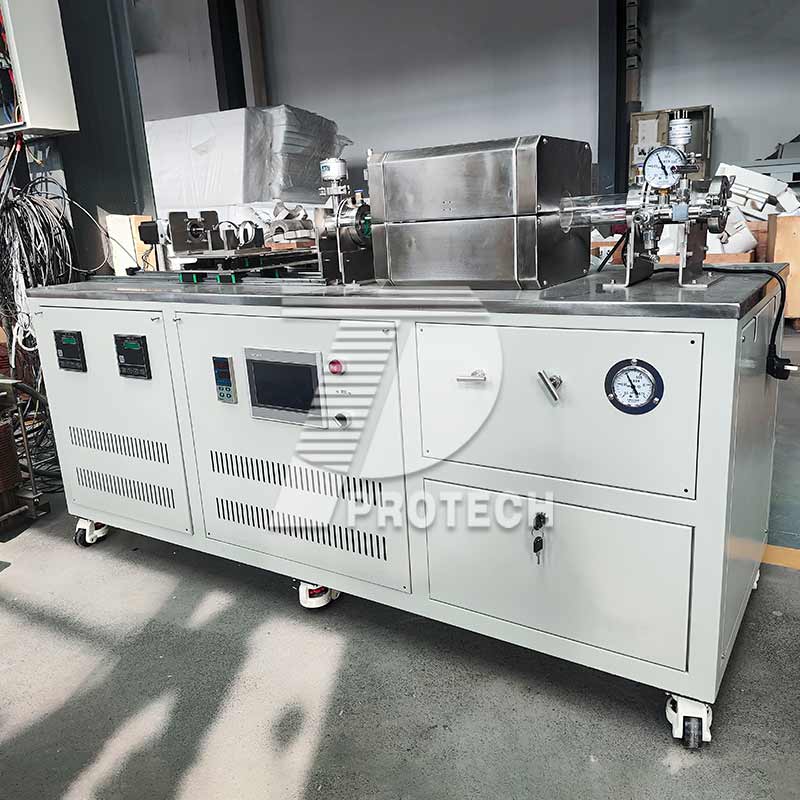
CVD furnace
Ro8Muffle Furnace,Tube Furnace,Vacuum Furnace,Atmosphere Furnac
2. Core Principle of CVD for DLC Film DepositionRo8Muffle Furnace,Tube Furnace,Vacuum Furnace,Atmosphere Furnac
Ro8Muffle Furnace,Tube Furnace,Vacuum Furnace,Atmosphere Furnac
Chemical Vapor Deposition (CVD) feeds carbon-containing precursor gases (methane, acetylene, etc.) into a vacuum chamber, paired with hydrogen and argon as dilution gases. Activated by plasma, hot filament or microwave, precursors decompose into reactive hydrocarbon radicals, which adsorb and react on the heated WC cemented carbide surface to form an amorphous or microcrystalline DLC film.Ro8Muffle Furnace,Tube Furnace,Vacuum Furnace,Atmosphere Furnac
Ro8Muffle Furnace,Tube Furnace,Vacuum Furnace,Atmosphere Furnac
DLC is a hybrid of sp² and sp³ hybridized carbon; higher sp³ content brings closer-to-diamond hardness and better wear resistance, while trace hydrogen lowers friction further. For WC cemented carbide, the key is controlling deposition temperature, gas ratio and plasma power to avoid excessive cobalt (Co) binder diffusion, which causes film graphitization, poor adhesion and cracking.
Ro8Muffle Furnace,Tube Furnace,Vacuum Furnace,Atmosphere Furnac
3. Complete CVD DLC Coating Process for WC Cemented CarbideRo8Muffle Furnace,Tube Furnace,Vacuum Furnace,Atmosphere Furnac
Ro8Muffle Furnace,Tube Furnace,Vacuum Furnace,Atmosphere Furnac
3.1 Workpiece Pretreatment: Substrate Cleaning and Surface ActivationRo8Muffle Furnace,Tube Furnace,Vacuum Furnace,Atmosphere Furnac
Ro8Muffle Furnace,Tube Furnace,Vacuum Furnace,Atmosphere Furnac
WC cemented carbide contains a cobalt binder that impairs coating adhesion and inhibits sp³ bond formation, so thorough pretreatment is critical to ensure surface cleanliness and remove surface-enriched cobalt.Ro8Muffle Furnace,Tube Furnace,Vacuum Furnace,Atmosphere Furnac
Ro8Muffle Furnace,Tube Furnace,Vacuum Furnace,Atmosphere Furnac
1. Ultrasonic Degreasing: Clean workpieces sequentially in alkaline degreaser, anhydrous ethanol and deionized water for 15–20 minutes each, then dry with high-purity nitrogen to eliminate oil and water marks.Ro8Muffle Furnace,Tube Furnace,Vacuum Furnace,Atmosphere Furnac
Ro8Muffle Furnace,Tube Furnace,Vacuum Furnace,Atmosphere Furnac
2. Sandblasting Finishing: Use fine white corundum micro-sand for light sandblasting to remove scale and burrs, controlling surface roughness Ra at 0.2–0.4μm for balanced adhesion and stress.Ro8Muffle Furnace,Tube Furnace,Vacuum Furnace,Atmosphere Furnac
Ro8Muffle Furnace,Tube Furnace,Vacuum Furnace,Atmosphere Furnac
3. Decobalt Etching: Mildly etch the surface with dilute acid to remove excess cobalt within 0.5–1μm depth, avoiding substrate strength loss, then rinse and transfer quickly to the vacuum chamber to prevent re-oxidation.Ro8Muffle Furnace,Tube Furnace,Vacuum Furnace,Atmosphere Furnac
Ro8Muffle Furnace,Tube Furnace,Vacuum Furnace,Atmosphere Furnac
4. Vacuum Degassing: Pump the chamber to ≤5×10⁻³Pa, heat to 150–200℃ and hold for 30–60 minutes to remove adsorbed moisture and volatile gases, avoiding pores and inclusions.Ro8Muffle Furnace,Tube Furnace,Vacuum Furnace,Atmosphere Furnac
Ro8Muffle Furnace,Tube Furnace,Vacuum Furnace,Atmosphere Furnac
3.2 Transition Layer DepositionRo8Muffle Furnace,Tube Furnace,Vacuum Furnace,Atmosphere Furnac
Ro8Muffle Furnace,Tube Furnace,Vacuum Furnace,Atmosphere Furnac
WC cemented carbide and DLC have mismatched crystal structures and thermal expansion rates, so a metal transition layer (Ti, Cr, TiN or CrN) is required to prevent stress-induced peeling. Deposited via magnetron sputtering at 0.1–0.3μm thick, it buffers stress, blocks cobalt diffusion and boosts coating-substrate bonding.Ro8Muffle Furnace,Tube Furnace,Vacuum Furnace,Atmosphere Furnac
Ro8Muffle Furnace,Tube Furnace,Vacuum Furnace,Atmosphere Furnac
3.3 DLC Film Deposition (PECVD)Ro8Muffle Furnace,Tube Furnace,Vacuum Furnace,Atmosphere Furnac
Ro8Muffle Furnace,Tube Furnace,Vacuum Furnace,Atmosphere Furnac
Plasma-Enhanced CVD (PECVD) is the preferred process, with low deposition temperature (100–300℃) to avoid cobalt diffusion, suitable for precision parts. Core parameters:Chamber Vacuum: Ultimate vacuum ≤8×10⁻⁴Pa, working pressure 10–50PaDeposition Temperature: 180–250℃ to retain substrate mechanical propertiesGas Flow: Carbon source (CH₄/C₂H₂) 20–50sccm, H₂+Ar 80–150sccm, ratio 1:4–1:6Plasma Power: 300–800W to avoid graphitizationDeposition Time: 2–6 hours for 1–5μm thick coatingsRo8Muffle Furnace,Tube Furnace,Vacuum Furnace,Atmosphere Furnac
Ro8Muffle Furnace,Tube Furnace,Vacuum Furnace,Atmosphere Furnac
3.4 Post-Treatment and CoolingRo8Muffle Furnace,Tube Furnace,Vacuum Furnace,Atmosphere Furnac
Ro8Muffle Furnace,Tube Furnace,Vacuum Furnace,Atmosphere Furnac
After deposition, turn off plasma and carbon source, keep argon flowing, and cool the chamber slowly to room temperature before gradual vacuum breaking to avoid stress spikes and cracking. High-precision parts can undergo light polishing for smoother surface, followed by adhesion and hardness testing to screen unqualified products.
Ro8Muffle Furnace,Tube Furnace,Vacuum Furnace,Atmosphere Furnac
4. Process Optimization and Quality ControlRo8Muffle Furnace,Tube Furnace,Vacuum Furnace,Atmosphere Furnac
Ro8Muffle Furnace,Tube Furnace,Vacuum Furnace,Atmosphere Furnac
- Cobalt Control: Keep deposition temperature below 300℃ with transition layer barrier, ensuring DLC sp³ carbon ratio ≥60%Ro8Muffle Furnace,Tube Furnace,Vacuum Furnace,Atmosphere Furnac
Ro8Muffle Furnace,Tube Furnace,Vacuum Furnace,Atmosphere Furnac
- Stress Control: Adjust gas ratio and deposition rate to set internal stress at 1–3GPa, preventing crackingRo8Muffle Furnace,Tube Furnace,Vacuum Furnace,Atmosphere Furnac
Ro8Muffle Furnace,Tube Furnace,Vacuum Furnace,Atmosphere Furnac
- Uniformity: Use rotating fixtures for even deposition, thickness deviation ≤±0.2μmRo8Muffle Furnace,Tube Furnace,Vacuum Furnace,Atmosphere Furnac
Ro8Muffle Furnace,Tube Furnace,Vacuum Furnace,Atmosphere Furnac
- Quality Standards: Scratch adhesion ≥50N, hardness ≥2000HV, friction coefficient ≤0.15, salt spray resistance ≥200h
Ro8Muffle Furnace,Tube Furnace,Vacuum Furnace,Atmosphere Furnac
5. Common Issues and TroubleshootingRo8Muffle Furnace,Tube Furnace,Vacuum Furnace,Atmosphere Furnac
Ro8Muffle Furnace,Tube Furnace,Vacuum Furnace,Atmosphere Furnac
In actual production, several common defects may occur with CVD DLC coatings on WC cemented carbide, along with targeted solutions. The first common issue is coating peeling or blistering, which is mainly caused by insufficient surface pretreatment, excessive cobalt content on the substrate surface, lack of a metal transition layer, or rapid furnace cooling after deposition. To fix this, strengthen the overall workpiece cleaning process, optimize the decobalt etching step, add a proper metal transition layer before DLC deposition, and adopt slow furnace cooling to release internal stress.Ro8Muffle Furnace,Tube Furnace,Vacuum Furnace,Atmosphere Furnac
The second frequent problem is low coating hardness, typically resulting from a low proportion of sp³ hybridized carbon in the film, excessively high deposition temperature, or inappropriate plasma power. The corrective measures include lowering the deposition temperature within a reasonable range, adjusting the ratio of carbon source to dilution gas, and optimizing the plasma power to promote sufficient formation of sp³ carbon bonds.Ro8Muffle Furnace,Tube Furnace,Vacuum Furnace,Atmosphere Furnac
Ro8Muffle Furnace,Tube Furnace,Vacuum Furnace,Atmosphere Furnac
The third common defect is the appearance of pores or pinholes on the coating surface, rooted in insufficient chamber vacuum, incomplete workpiece degassing before deposition, or use of low-purity reaction gases. The solutions are to increase the ultimate vacuum of the reaction chamber, extend the vacuum baking and degassing time, and replace with high-purity carbon source and protective gases to ensure a dense coating structure.
Ro8Muffle Furnace,Tube Furnace,Vacuum Furnace,Atmosphere Furnac
6. Application ProspectsRo8Muffle Furnace,Tube Furnace,Vacuum Furnace,Atmosphere Furnac
Ro8Muffle Furnace,Tube Furnace,Vacuum Furnace,Atmosphere Furnac
CVD-DLC coated WC cemented carbide is widely used in high-speed cutting tools, precision molds, mechanical seals and mining parts, especially for machining viscous materials like aluminum and copper alloys. It eliminates adhesion and rapid wear, reduces lubrication demand, and supports dry or minimal-lubrication cutting in line with green manufacturing trends.Ro8Muffle Furnace,Tube Furnace,Vacuum Furnace,Atmosphere Furnac
Ro8Muffle Furnace,Tube Furnace,Vacuum Furnace,Atmosphere Furnac
7. ConclusionRo8Muffle Furnace,Tube Furnace,Vacuum Furnace,Atmosphere Furnac
Ro8Muffle Furnace,Tube Furnace,Vacuum Furnace,Atmosphere Furnac
CVD-prepared DLC coating is an efficient and reliable surface strengthening method for WC cemented carbide, with core steps of thorough pretreatment, proper transition layer and precise low-temperature parameter control. As high-end manufacturing develops, this process will keep optimizing, expand WC cemented carbide applications, and provide core technical support for longer component lifespan and higher efficiency.Ro8Muffle Furnace,Tube Furnace,Vacuum Furnace,Atmosphere Furnac
Ro8Muffle Furnace,Tube Furnace,Vacuum Furnace,Atmosphere Furnac
Zhengzhou Protech Technology Co.,LTD is a professional manufacturer specializing in tube furnaces, muffle furnaces, atmosphere furnaces, and vacuum furnaces. We are committed to providing targeted solutions to meet your diverse heating equipment needs.Ro8Muffle Furnace,Tube Furnace,Vacuum Furnace,Atmosphere Furnac
For customized heating solutions tailored to your specific requirements, feel free to get in touch with us:Ro8Muffle Furnace,Tube Furnace,Vacuum Furnace,Atmosphere Furnac
WhatsApp: +86 17719806024Ro8Muffle Furnace,Tube Furnace,Vacuum Furnace,Atmosphere Furnac
Email: info@lab-furnace.com