Zhengzhou Protech
Home > News

Product

Contact Us

Leave Message

Contact Us

All products are customizable, leave message immediately, we will reply as soon as possible.

Name

Tel/WhatsApp

E-mail *

Country *

Raw Materia

Message *

Verification code *

I can't see clearly, refresh

Vacuum Furnace Sintering of Cemented Carbides: Key Points for Stainless Steel/Titanium Alloy/Diamond

1. Introductionq6dMuffle Furnace,Tube Furnace,Vacuum Furnace,Atmosphere Furnac
Cemented carbides are widely used in mechanical processing, aerospace, mining and electronics due to their high strength, hardness, wear and high-temperature resistance. As a core preparation process, vacuum furnace sintering precisely controls temperature, pressure and holding time to reduce pores and oxide inclusions, enhancing material density and mechanical properties. This article focuses on vacuum sintering of cemented carbides, highlighting key technologies for stainless steel, titanium alloy and diamond to guide production and process optimization.q6dMuffle Furnace,Tube Furnace,Vacuum Furnace,Atmosphere Furnac
q6dMuffle Furnace,Tube Furnace,Vacuum Furnace,Atmosphere Furnac
2. Basic Process Principle of Vacuum Furnace Sintering for Cemented Carbidesq6dMuffle Furnace,Tube Furnace,Vacuum Furnace,Atmosphere Furnac
The core principle of vacuum furnace sintering is to heat cemented carbide powder (a mixture of hard phases like WC/TiC and binders like Co/Ni) in a sub-atmospheric vacuum environment, inducing particle rearrangement, plastic flow, and dissolution-reprecipitation to form dense, uniform alloy compacts. Vacuum advantages include: rapid discharge of sintering gases (adsorbed water, organic decomposition gas) to avoid pores; prevention of metal oxidation to ensure purity; and precise control of sintering atmosphere for different materials.q6dMuffle Furnace,Tube Furnace,Vacuum Furnace,Atmosphere Furnac
q6dMuffle Furnace,Tube Furnace,Vacuum Furnace,Atmosphere Furnac
The basic process includes pre-sintering preparation (powder mixing, forming, drying), furnace loading, heating, holding, cooling, and post-treatment. Heating rate, holding temperature/time, and cooling rate are three core parameters that require precise adjustment based on material characteristics.
q6dMuffle Furnace,Tube Furnace,Vacuum Furnace,Atmosphere Furnac
 
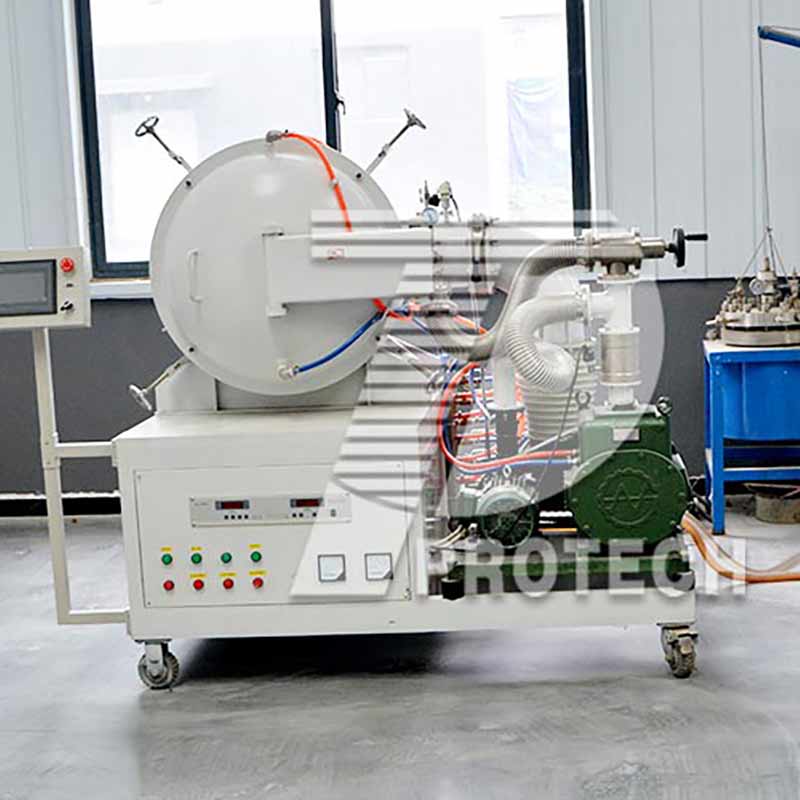
vacuum furnace
q6dMuffle Furnace,Tube Furnace,Vacuum Furnace,Atmosphere Furnac
3. Technical Points of Vacuum Furnace Sintering for Different Cemented Carbide Materialq6dMuffle Furnace,Tube Furnace,Vacuum Furnace,Atmosphere Furnac
q6dMuffle Furnace,Tube Furnace,Vacuum Furnace,Atmosphere Furnac
3.1 Technical Points of Vacuum Furnace Sintering for Stainless Steel Cemented Carbidesq6dMuffle Furnace,Tube Furnace,Vacuum Furnace,Atmosphere Furnac
Stainless steel cemented carbide, composed of stainless steel powder matrix, hard phases (WC/TiN) and binders, combines corrosion resistance and high hardness, suitable for wear-resistant/corrosion-resistant parts. Key vacuum sintering technologies are as follows:q6dMuffle Furnace,Tube Furnace,Vacuum Furnace,Atmosphere Furnac
1. Sintering atmosphere control: Adopt high vacuum (≥10⁻³ Pa) to avoid reaction between stainless steel and air oxygen/nitrogen. Introduce trace argon to balance carbon content if decarburization occurs, preventing hardness reduction.q6dMuffle Furnace,Tube Furnace,Vacuum Furnace,Atmosphere Furnac
2. Temperature regulation: Adopt stepwise heating: slow heating (5-8℃/min) at 200-600℃ to remove moisture and binder; increase rate to 10-15℃/min at 600-1200℃; hold at 1350-1450℃ for 60-120min (adjustable by grade and hard phase content) to ensure uniform hard phase dissolution.q6dMuffle Furnace,Tube Furnace,Vacuum Furnace,Atmosphere Furnac
3. Cooling rate control: Stepwise cooling: rapid cooling (≥20℃/min) at 1450-800℃ to inhibit grain growth; slow cooling (5-10℃/min) below 800℃ to reduce internal stress and prevent deformation/cracking.q6dMuffle Furnace,Tube Furnace,Vacuum Furnace,Atmosphere Furnac
4. Pre-sintering pretreatment: Vacuum-dry compacts at 120-150℃ for 2-4h to reduce moisture content below 0.1%, as stainless steel powder easily absorbs moisture and oxygen.
q6dMuffle Furnace,Tube Furnace,Vacuum Furnace,Atmosphere Furnac
3.2 Technical Points of Vacuum Furnace Sintering for Titanium Alloy Cemented Carbidesq6dMuffle Furnace,Tube Furnace,Vacuum Furnace,Atmosphere Furnac
Titanium alloy cemented carbide, based on TiC/TiN hard phases and Co/Ni binders, features low density, high strength and high-temperature corrosion resistance, critical for aerospace engine and structural parts. Key technologies focus on titanium oxidation inhibition and structure uniformity:q6dMuffle Furnace,Tube Furnace,Vacuum Furnace,Atmosphere Furnac
1. Ultra-high vacuum guarantee: Sinter at 10⁻⁴ - 10⁻⁵ Pa (titanium reacts easily with gases at high temperatures). Pre-bake the furnace to remove adsorbed gases.q6dMuffle Furnace,Tube Furnace,Vacuum Furnace,Atmosphere Furnac
2. Precise temperature control: Heat at 3-8℃/min to avoid internal stress. Hold at 1400-1550℃ for 90-180min (adjustable by composition) to ensure binder wets hard phases and improves density.q6dMuffle Furnace,Tube Furnace,Vacuum Furnace,Atmosphere Furnac
3. Atmosphere purification: Degrease compacts at 300-500℃ for 4-6h in low vacuum. Use high-temperature stable heating elements (tungsten/molybdenum) to avoid contamination.q6dMuffle Furnace,Tube Furnace,Vacuum Furnace,Atmosphere Furnac
4. Cooling and heat treatment coordination: Combine vacuum cooling (≥15℃/min at 1550-1000℃) and argon cooling (below 1000℃). Age at 500-600℃ for 2-3h to eliminate internal stress and optimize properties.
q6dMuffle Furnace,Tube Furnace,Vacuum Furnace,Atmosphere Furnac
3.3 Technical Points of Vacuum Furnace Sintering for Diamond Cemented Carbidesq6dMuffle Furnace,Tube Furnace,Vacuum Furnace,Atmosphere Furnac
Diamond cemented carbide, a composite of diamond particles and WC-Co matrix, combines ultra-high hardness and toughness, core for superhard tools and drilling bits. Key technologies focus on firm bonding and avoiding diamond graphitization:q6dMuffle Furnace,Tube Furnace,Vacuum Furnace,Atmosphere Furnac
1. Low-temperature sintering: Control temperature at 900-1100℃ (avoid >1200℃ to prevent graphitization). Adopt high vacuum (≥10⁻³ Pa) or argon protection to avoid oxidation.q6dMuffle Furnace,Tube Furnace,Vacuum Furnace,Atmosphere Furnac
2. Binder optimization: Add trace Ti/Cr to WC-Co binder to form TiC/Cr₃C₂ transition layers via surface reaction, enhancing diamond-matrix bonding.q6dMuffle Furnace,Tube Furnace,Vacuum Furnace,Atmosphere Furnac
3. Pressure-assisted sintering: Apply 10-30MPa pressure during vacuum sintering to promote matrix densification, improve binder wetting and reduce interface gaps.q6dMuffle Furnace,Tube Furnace,Vacuum Furnace,Atmosphere Furnac
4. Parameter matching: Heat slowly (2-5℃/min) to avoid graphitization; hold for 30-60min for sufficient reaction; cool slowly (5-10℃/min) to reduce thermal stress and interface cracking.
q6dMuffle Furnace,Tube Furnace,Vacuum Furnace,Atmosphere Furnac
4. Quality Control Points of Vacuum Furnace Sintering for Cemented Carbidesq6dMuffle Furnace,Tube Furnace,Vacuum Furnace,Atmosphere Furnac
1. Raw material control: Ensure powder purity (≥99.5%), uniform particle size and precise binder addition (error ±0.5%) to avoid impurity impact.q6dMuffle Furnace,Tube Furnace,Vacuum Furnace,Atmosphere Furnac
2. Process monitoring: Use high-precision temperature control (fluctuation ±5℃) and vacuum monitoring. Record parameter curves for quality traceability and optimization.q6dMuffle Furnace,Tube Furnace,Vacuum Furnace,Atmosphere Furnac
3. Product inspection: Test density (≥98.5%), hardness and mechanical properties. Observe microstructure to detect defects. Repair slight defects via secondary sintering; optimize process for severe defects.
q6dMuffle Furnace,Tube Furnace,Vacuum Furnace,Atmosphere Furnac
5. Summary and Development Trendq6dMuffle Furnace,Tube Furnace,Vacuum Furnace,Atmosphere Furnac
Vacuum furnace sintering is key for high-performance cemented carbides. Precisely control vacuum degree, temperature, holding time and cooling rate based on material characteristics, and strengthen raw material and product control to ensure quality stability.q6dMuffle Furnace,Tube Furnace,Vacuum Furnace,Atmosphere Furnac
q6dMuffle Furnace,Tube Furnace,Vacuum Furnace,Atmosphere Furnac
Future trends: intelligent control with AI for parameter optimization; advanced vacuum furnaces for precise control and continuous sintering; low-temperature sintering and new binders to enhance performance and expand high-end applications.q6dMuffle Furnace,Tube Furnace,Vacuum Furnace,Atmosphere Furnac
q6dMuffle Furnace,Tube Furnace,Vacuum Furnace,Atmosphere Furnac
Zhengzhou Protech Technology Co.,LTD is a professional manufacturer specializing in tube furnaces, muffle furnaces, atmosphere furnaces, and vacuum furnaces. We are committed to providing targeted solutions to meet your diverse heating equipment needs.q6dMuffle Furnace,Tube Furnace,Vacuum Furnace,Atmosphere Furnac
For customized heating solutions tailored to your specific requirements, feel free to get in touch with us:q6dMuffle Furnace,Tube Furnace,Vacuum Furnace,Atmosphere Furnac
WhatsApp: +86 17719806024q6dMuffle Furnace,Tube Furnace,Vacuum Furnace,Atmosphere Furnac
Email: info@lab-furnace.com