Zhengzhou Protech
Home > News

Product

Contact Us

Leave Message

Contact Us

All products are customizable, leave message immediately, we will reply as soon as possible.

Name

Tel/WhatsApp

E-mail *

Country *

Raw Materia

Message *

Verification code *

I can't see clearly, refresh

Tube Furnace Preparation of MoS₂ Coating: Technology for S101/SiO₂ Substrate

As a typical two-dimensional transition metal dichalcogenide, molybdenum disulfide (MoS₂) has excellent electrical on-off ratio, chemical and thermal stability, offering broad prospects in optoelectronic devices, lithium-ion batteries and field-effect transistors. Compared with mechanical exfoliation, the tube furnace chemical vapor deposition (CVD) method ensures large-area uniform MoS₂ coatings with controllable layers and strong silicon-based process compatibility, becoming the mainstream for high-quality MoS₂ coatings on S101/SiO₂ substrates. This paper analyzes the core principle, operation process, key parameter optimization and performance characterization of this tube furnace CVD process, providing references for R&D and industrial application.ZsSMuffle Furnace,Tube Furnace,Vacuum Furnace,Atmosphere Furnac
ZsSMuffle Furnace,Tube Furnace,Vacuum Furnace,Atmosphere Furnac
I. Core Principle of the ProcessZsSMuffle Furnace,Tube Furnace,Vacuum Furnace,Atmosphere Furnac
ZsSMuffle Furnace,Tube Furnace,Vacuum Furnace,Atmosphere Furnac
The tube furnace preparation of MoS₂ coating relies on high-temperature CVD gas-phase reaction between molybdenum and sulfur sources. Generated MoS₂ active species deposit and crystallize on S101/SiO₂ substrates to form continuous uniform coatings. The substrate’s surface SiO₂ layer, with good insulation, flatness and MoS₂ compatibility, regulates nucleation density and crystallization quality, facilitating high-performance two-dimensional coatings—an advantage critical for optimizing the tube furnace CVD process.ZsSMuffle Furnace,Tube Furnace,Vacuum Furnace,Atmosphere Furnac
ZsSMuffle Furnace,Tube Furnace,Vacuum Furnace,Atmosphere Furnac
Typically, molybdenum trioxide (MoO₃) and sulfur powder (S) serve as sources, with high-purity Ar or N₂ as carrier gas. Trace H₂ or O₂ may be added for slight etching to repair defects and terminate single-layer growth, enabling controllable double/multi-layer coatings. The core reaction is:ZsSMuffle Furnace,Tube Furnace,Vacuum Furnace,Atmosphere Furnac
ZsSMuffle Furnace,Tube Furnace,Vacuum Furnace,Atmosphere Furnac
2MoO₃ + 7S → 2MoS₂ + 3SO₂↑
ZsSMuffle Furnace,Tube Furnace,Vacuum Furnace,Atmosphere Furnac
 
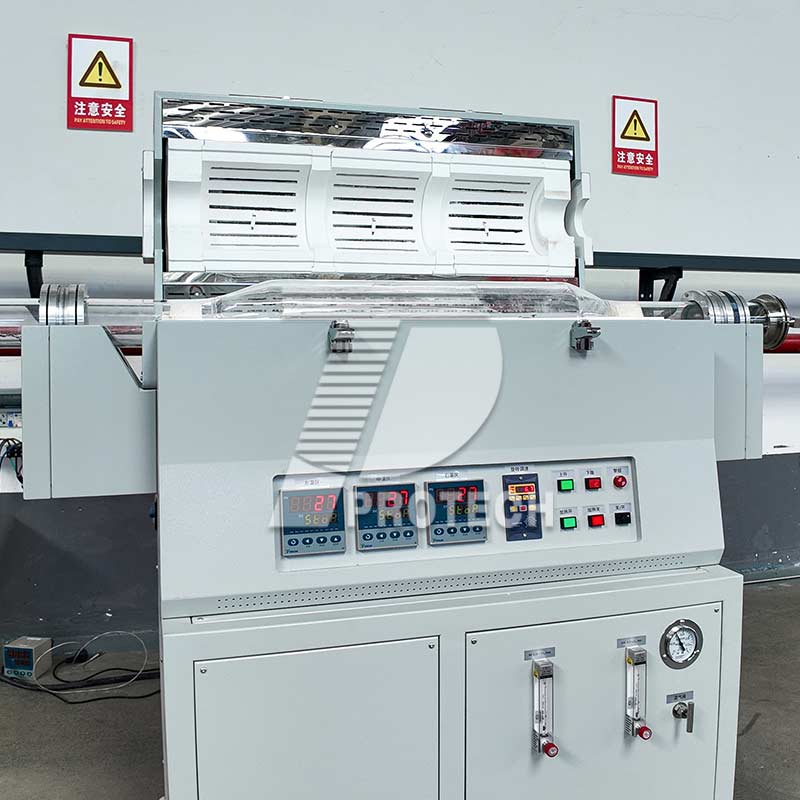
tube furnace
ZsSMuffle Furnace,Tube Furnace,Vacuum Furnace,Atmosphere Furnac
II. Detailed Process Operation FlowZsSMuffle Furnace,Tube Furnace,Vacuum Furnace,Atmosphere Furnac
ZsSMuffle Furnace,Tube Furnace,Vacuum Furnace,Atmosphere Furnac
2.1 Substrate PretreatmentZsSMuffle Furnace,Tube Furnace,Vacuum Furnace,Atmosphere Furnac
ZsSMuffle Furnace,Tube Furnace,Vacuum Furnace,Atmosphere Furnac
Surface cleanliness of S101/SiO₂ substrates directly affects coating adhesion and crystallization. Multi-step cleaning removes oil, impurities and hydroxyl groups:ZsSMuffle Furnace,Tube Furnace,Vacuum Furnace,Atmosphere Furnac
ZsSMuffle Furnace,Tube Furnace,Vacuum Furnace,Atmosphere Furnac
1. Ultrasonically clean the substrate in acetone, absolute ethanol and deionized water (10-15 minutes each) to remove organic pollutants and particles;ZsSMuffle Furnace,Tube Furnace,Vacuum Furnace,Atmosphere Furnac
ZsSMuffle Furnace,Tube Furnace,Vacuum Furnace,Atmosphere Furnac
2. After cleaning, blow dry the surface moisture of the substrate with high-purity nitrogen (purity ≥99.999%) to avoid residual water stains causing coating defects;ZsSMuffle Furnace,Tube Furnace,Vacuum Furnace,Atmosphere Furnac
ZsSMuffle Furnace,Tube Furnace,Vacuum Furnace,Atmosphere Furnac
3. Optional step: Place the dried substrate in a tube furnace and perform thermal annealing at 300-400℃ for 30 minutes to further remove residual water vapor and adsorbed impurities on the surface.
ZsSMuffle Furnace,Tube Furnace,Vacuum Furnace,Atmosphere Furnac
2.2 Reaction System ConstructionZsSMuffle Furnace,Tube Furnace,Vacuum Furnace,Atmosphere Furnac
ZsSMuffle Furnace,Tube Furnace,Vacuum Furnace,Atmosphere Furnac
A dual/three-zone tube furnace builds the reaction system, requiring precise control of component placement and ratio:ZsSMuffle Furnace,Tube Furnace,Vacuum Furnace,Atmosphere Furnac
ZsSMuffle Furnace,Tube Furnace,Vacuum Furnace,Atmosphere Furnac
1. Sulfur source placement: Put sulfur powder into a quartz boat and place it in the low-temperature zone upstream of the gas flow in the tube furnace, which is heated and evaporated by thermal radiation from the molybdenum source zone;ZsSMuffle Furnace,Tube Furnace,Vacuum Furnace,Atmosphere Furnac
ZsSMuffle Furnace,Tube Furnace,Vacuum Furnace,Atmosphere Furnac
2. Molybdenum source placement: Put MoO₃ powder (purity ≥99.9%) into another quartz boat, and place it together with the pretreated S101/SiO₂ substrate in the high-temperature zone downstream of the gas flow. The substrate can be buckled upside down above the molybdenum source or placed horizontally near the downstream to ensure uniform coverage of gas-phase species;ZsSMuffle Furnace,Tube Furnace,Vacuum Furnace,Atmosphere Furnac
ZsSMuffle Furnace,Tube Furnace,Vacuum Furnace,Atmosphere Furnac
3. Source distance: Control MoO₃-sulfur horizontal spacing at 25-40cm. Excessively close spacing causes premature sulfur evaporation; overly far leads to insufficient sulfur and incomplete vulcanization;ZsSMuffle Furnace,Tube Furnace,Vacuum Furnace,Atmosphere Furnac
ZsSMuffle Furnace,Tube Furnace,Vacuum Furnace,Atmosphere Furnac
4. Vacuum and carrier gas replacement: After closing the tube furnace chamber, evacuate to 10⁻³Pa level, and flush the chamber with high-purity carrier gas 3-5 times to completely eliminate air impurities and avoid oxidation reactions affecting coating quality.
ZsSMuffle Furnace,Tube Furnace,Vacuum Furnace,Atmosphere Furnac
2.3 Temperature Control and Reaction ProcessZsSMuffle Furnace,Tube Furnace,Vacuum Furnace,Atmosphere Furnac
ZsSMuffle Furnace,Tube Furnace,Vacuum Furnace,Atmosphere Furnac
Segmented heating enables controllable coating growth, with typical parameters as follows:ZsSMuffle Furnace,Tube Furnace,Vacuum Furnace,Atmosphere Furnac
ZsSMuffle Furnace,Tube Furnace,Vacuum Furnace,Atmosphere Furnac
1. Preheating: Heat at 5-30℃/min to 150-350℃ (molybdenum source/substrate zones), hold 60-180 minutes to purify the substrate and preheat sources;ZsSMuffle Furnace,Tube Furnace,Vacuum Furnace,Atmosphere Furnac
ZsSMuffle Furnace,Tube Furnace,Vacuum Furnace,Atmosphere Furnac
2. Pre-evaporation and pre-nucleation stage: Adjust the temperature of the molybdenum source zone to 600-800℃, the temperature of the substrate zone to 600-750℃, control the temperature difference between the two zones at -150~150℃, and keep it warm for 10-40 minutes to make MoO₃ evaporate initially to form gaseous MoO₃₋ₓ species and pre-nucleate on the substrate surface;ZsSMuffle Furnace,Tube Furnace,Vacuum Furnace,Atmosphere Furnac
ZsSMuffle Furnace,Tube Furnace,Vacuum Furnace,Atmosphere Furnac
3. Main growth: Heat sulfur zone to 130-220℃, molybdenum source zone to 800-900℃, substrate zone to 700-850℃, hold 10-60 minutes. Adjust carrier gas flow to 10-80sccm to carry vapors for MoS₂ deposition. For double layers, add 1-10sccm H₂/O₂ for etching to terminate the first layer before re-deposition;ZsSMuffle Furnace,Tube Furnace,Vacuum Furnace,Atmosphere Furnac
ZsSMuffle Furnace,Tube Furnace,Vacuum Furnace,Atmosphere Furnac
4. Cooling stage: After the reaction, turn off the heat source, keep the carrier gas continuously flowing, and let the tube furnace cool down to room temperature naturally to avoid coating cracking or peeling caused by rapid cooling.
ZsSMuffle Furnace,Tube Furnace,Vacuum Furnace,Atmosphere Furnac
III. Key Parameter Optimization PointsZsSMuffle Furnace,Tube Furnace,Vacuum Furnace,Atmosphere Furnac
ZsSMuffle Furnace,Tube Furnace,Vacuum Furnace,Atmosphere Furnac
3.1 Temperature ParametersZsSMuffle Furnace,Tube Furnace,Vacuum Furnace,Atmosphere Furnac
ZsSMuffle Furnace,Tube Furnace,Vacuum Furnace,Atmosphere Furnac
Temperature is core for regulating MoS₂ coating layers and crystallization. The first substrate preset temperature (650-750℃) determines nucleation density, yielding uniform single layers with 5-25 minutes of holding. The second preset temperature (750-900℃, higher than the first) with 10-35 minutes of holding (longer than the first) enables second-layer growth. Molybdenum source-substrate temperature difference is critical: negative difference (molybdenum source < substrate) reduces nucleation density (suitable for single layers); positive difference increases thickness (facilitating multi-layer/rod-like structures).ZsSMuffle Furnace,Tube Furnace,Vacuum Furnace,Atmosphere Furnac
ZsSMuffle Furnace,Tube Furnace,Vacuum Furnace,Atmosphere Furnac
3.2 Carrier Gas and Source Material RatioZsSMuffle Furnace,Tube Furnace,Vacuum Furnace,Atmosphere Furnac
ZsSMuffle Furnace,Tube Furnace,Vacuum Furnace,Atmosphere Furnac
Optimal carrier gas flow is 50-100sccm: too low causes insufficient sulfur and incomplete vulcanization; too high boosts nucleation density and reduces coating size. Control sulfur-MoO₃ mass ratio at 20:1~250:1—excess sulfur avoids MoO₁₋ₓSₓ impurities and improves purity.ZsSMuffle Furnace,Tube Furnace,Vacuum Furnace,Atmosphere Furnac
ZsSMuffle Furnace,Tube Furnace,Vacuum Furnace,Atmosphere Furnac
3.3 Substrate Selection and TreatmentZsSMuffle Furnace,Tube Furnace,Vacuum Furnace,Atmosphere Furnac
ZsSMuffle Furnace,Tube Furnace,Vacuum Furnace,Atmosphere Furnac
The thickness of the SiO₂ layer of the S101/SiO₂ substrate is recommended to be controlled at about 280nm. Too thick will easily lead to decreased coating adhesion, and too thin will affect insulation performance. The substrate after ultrasonic cleaning must be thoroughly dried to avoid residual moisture causing coating defects at high temperature.ZsSMuffle Furnace,Tube Furnace,Vacuum Furnace,Atmosphere Furnac
ZsSMuffle Furnace,Tube Furnace,Vacuum Furnace,Atmosphere Furnac
IV. Coating Performance Characterization MethodsZsSMuffle Furnace,Tube Furnace,Vacuum Furnace,Atmosphere Furnac
ZsSMuffle Furnace,Tube Furnace,Vacuum Furnace,Atmosphere Furnac
1. Raman spectroscopy: Determine layers and crystallization via characteristic peak spacing. Single-layer MoS₂ has ~20cm⁻¹ spacing between E₁₂g (~384cm⁻¹) and A₁g (~404cm⁻¹) peaks; double/multi-layers exceed 24cm⁻¹ (e.g., 24.5cm⁻¹ for 5 layers);ZsSMuffle Furnace,Tube Furnace,Vacuum Furnace,Atmosphere Furnac
ZsSMuffle Furnace,Tube Furnace,Vacuum Furnace,Atmosphere Furnac
2. Atomic Force Microscopy (AFM): Observe the surface morphology and thickness of the coating. High-quality coatings have triangular or hexagonal island-like structures on the surface, no obvious particle agglomeration, and uniform and controllable thickness;ZsSMuffle Furnace,Tube Furnace,Vacuum Furnace,Atmosphere Furnac
ZsSMuffle Furnace,Tube Furnace,Vacuum Furnace,Atmosphere Furnac
3. Photoluminescence (PL) spectroscopy: Analyze the optical properties of the coating. The free exciton and bound exciton characteristic peaks of single-layer MoS₂ are around 1.98eV and 1.84eV respectively, and the defect density can be judged by the peak intensity;ZsSMuffle Furnace,Tube Furnace,Vacuum Furnace,Atmosphere Furnac
ZsSMuffle Furnace,Tube Furnace,Vacuum Furnace,Atmosphere Furnac
4. X-ray Photoelectron Spectroscopy (XPS): Detect the elemental composition and bonding state of the coating. No additional shoulder peaks indicate no impurity phase, and the atomic ratio of Mo to S close to 1:2 is optimal.
ZsSMuffle Furnace,Tube Furnace,Vacuum Furnace,Atmosphere Furnac
V. Process Advantages and Application ScenariosZsSMuffle Furnace,Tube Furnace,Vacuum Furnace,Atmosphere Furnac
ZsSMuffle Furnace,Tube Furnace,Vacuum Furnace,Atmosphere Furnac
Tube furnace CVD on S101/SiO₂ substrates achieves large-area, layer-controllable high-quality MoS₂ coatings with excellent electrical/optical properties, overcoming mechanical exfoliation’s low yield and small size. This optimized combination suits back-gate transistors, photodetectors and photocatalytic electrodes. Particularly for next-generation semiconductors, it mitigates silicon-based short-channel effects, supporting Moore’s Law extension and laying the groundwork for industrialization.ZsSMuffle Furnace,Tube Furnace,Vacuum Furnace,Atmosphere Furnac
ZsSMuffle Furnace,Tube Furnace,Vacuum Furnace,Atmosphere Furnac
VI. ConclusionZsSMuffle Furnace,Tube Furnace,Vacuum Furnace,Atmosphere Furnac
ZsSMuffle Furnace,Tube Furnace,Vacuum Furnace,Atmosphere Furnac
Precise control of temperature difference, carrier gas flow and source ratio is key for tube furnace MoS₂ coating on S101/SiO₂ substrates. Segmented heating and slight etching enable controllable single/multi-layer growth. Future efforts will optimize parameters, reduce defects, enhance device compatibility and promote industrial application in optoelectronics and spintronics.ZsSMuffle Furnace,Tube Furnace,Vacuum Furnace,Atmosphere Furnac
ZsSMuffle Furnace,Tube Furnace,Vacuum Furnace,Atmosphere Furnac
Zhengzhou Protech Technology Co.,LTD is a professional manufacturer specializing in tube furnaces, muffle furnaces, atmosphere furnaces, and vacuum furnaces. We are committed to providing targeted solutions to meet your diverse heating equipment needs.ZsSMuffle Furnace,Tube Furnace,Vacuum Furnace,Atmosphere Furnac
ZsSMuffle Furnace,Tube Furnace,Vacuum Furnace,Atmosphere Furnac
For customized heating solutions tailored to your specific requirements, feel free to get in touch with us:ZsSMuffle Furnace,Tube Furnace,Vacuum Furnace,Atmosphere Furnac
WhatsApp: +86 17719806024ZsSMuffle Furnace,Tube Furnace,Vacuum Furnace,Atmosphere Furnac
Email: info@lab-furnace.com