Zhengzhou Protech
Home > News

Product

Contact Us

Leave Message

Contact Us

All products are customizable, leave message immediately, we will reply as soon as possible.
Name

Tel/WhatsApp

E-mail *

Country *

Raw Materia

Message *

Verification code *

I can't see clearly, refresh

Ceramic Sintering: Temperature Curve Optimization for Lab Furnaces

1. Process Background and Core ObjectivesTi4Muffle Furnace,Tube Furnace,Vacuum Furnace,Atmosphere Furnac
Ceramic powder sintering is a key process that converts loose powder into dense ceramic materials through high-temperature treatment, and its quality directly determines the mechanical properties, density, microstructure, and service stability of the products. As the core equipment for laboratory research and small-batch production, the rationality of the temperature curve design (time-series combination of heating rate, holding stage, and cooling rate) of laboratory electric furnaces is the core starting point for realizing sintering process optimization. The core objectives of optimization are: to improve the density of ceramic materials, reduce porosity, avoid defects such as cracking and deformation, and ensure the consistency of product performance while reducing sintering energy consumption and costs.Ti4Muffle Furnace,Tube Furnace,Vacuum Furnace,Atmosphere Furnac
Ti4Muffle Furnace,Tube Furnace,Vacuum Furnace,Atmosphere Furnac
2. Key Parameters and Influence Mechanisms of Temperature Curve DesignTi4Muffle Furnace,Tube Furnace,Vacuum Furnace,Atmosphere Furnac
Heating Rate ControlTi4Muffle Furnace,Tube Furnace,Vacuum Furnace,Atmosphere Furnac
The heating stage needs to balance efficiency and material stability: the low-temperature stage (room temperature to 600℃) is mainly used to remove adsorbed water and organic binders in the powder; an excessively fast rate can easily lead to the rapid volatilization of water/organic matter, generating internal stress and causing cracking. The medium-high temperature stage (600℃ to sintering temperature) should be adjusted according to powder characteristics: oxide ceramics (such as Al₂O₃, ZrO₂) can adopt 5-10℃/min, while non-oxide ceramics (such as Si₃N₄, SiC) need to be reduced to 2-5℃/min to avoid abnormal grain growth.Ti4Muffle Furnace,Tube Furnace,Vacuum Furnace,Atmosphere Furnac
Ti4Muffle Furnace,Tube Furnace,Vacuum Furnace,Atmosphere Furnac
Holding Stage DesignTi4Muffle Furnace,Tube Furnace,Vacuum Furnace,Atmosphere Furnac
Holding is the key to achieving particle diffusion and densification, and a multi-stage holding strategy should be adopted:Ti4Muffle Furnace,Tube Furnace,Vacuum Furnace,Atmosphere Furnac
Pre-holding stage (300-600℃): Hold for 30-60 minutes to completely remove residual organic matter and prevent bubble defects at high temperatures;Ti4Muffle Furnace,Tube Furnace,Vacuum Furnace,Atmosphere Furnac
Main holding stage (sintering temperature): Adjust according to powder particle size and target density; the smaller the particle size, the shorter the holding time (1-3 hours); when the particle size is larger, it needs to be extended to 3-6 hours to ensure sufficient particle fusion;Ti4Muffle Furnace,Tube Furnace,Vacuum Furnace,Atmosphere Furnac
Pre-cooling holding stage: Hold at 100-200℃ lower than the sintering temperature for 20-30 minutes to release internal thermal stress.Ti4Muffle Furnace,Tube Furnace,Vacuum Furnace,Atmosphere Furnac
Ti4Muffle Furnace,Tube Furnace,Vacuum Furnace,Atmosphere Furnac
Cooling Rate OptimizationTi4Muffle Furnace,Tube Furnace,Vacuum Furnace,Atmosphere Furnac
The cooling rate directly affects the grain size and internal stress of ceramic materials: rapid cooling can obtain a fine-grained structure, but it is prone to internal stress leading to cracking; slow cooling can release stress but may cause grain coarsening. The optimization scheme is: adopt a slow cooling rate of 2-3℃/min in the high-temperature stage (sintering temperature to 800℃), and increase to 5-8℃/min in the medium-low temperature stage (800℃ to room temperature) to balance grain size and internal stress.
Ti4Muffle Furnace,Tube Furnace,Vacuum Furnace,Atmosphere Furnac
3. Practical Design Skills for Temperature Curves of Laboratory Electric FurnacesTi4Muffle Furnace,Tube Furnace,Vacuum Furnace,Atmosphere Furnac
 
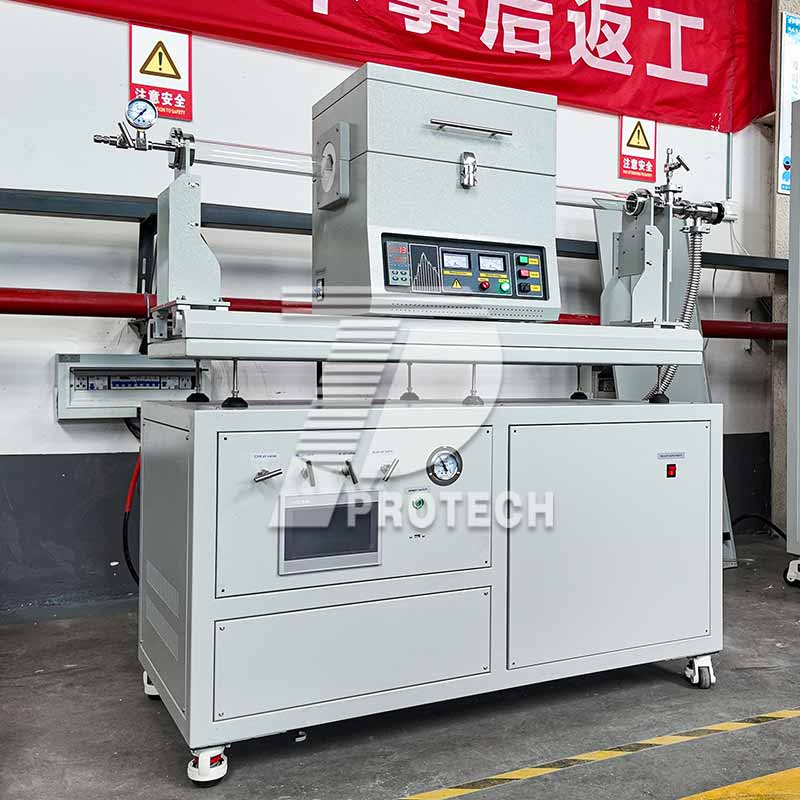
tube furnace
Personalized Adjustment Based on Powder CharacteristicsTi4Muffle Furnace,Tube Furnace,Vacuum Furnace,Atmosphere Furnac
Powders containing low-melting point additives: Need to reduce the heating rate (2-3℃/min) to avoid premature melting of additives leading to particle agglomeration;Ti4Muffle Furnace,Tube Furnace,Vacuum Furnace,Atmosphere Furnac
Nano-scale ceramic powders: Due to their large specific surface area and high activity, the sintering temperature can be appropriately reduced (50-100℃) and the holding time shortened to prevent excessive grain growth;Ti4Muffle Furnace,Tube Furnace,Vacuum Furnace,Atmosphere Furnac
Porous ceramic powders: Need to increase the heating rate (8-10℃/min) to reduce pore closure, and extend the low-temperature holding time to ensure complete decomposition of organic matter.Ti4Muffle Furnace,Tube Furnace,Vacuum Furnace,Atmosphere Furnac
Ti4Muffle Furnace,Tube Furnace,Vacuum Furnace,Atmosphere Furnac
Adaptation Optimization of Equipment CharacteristicsTi4Muffle Furnace,Tube Furnace,Vacuum Furnace,Atmosphere Furnac
The heating uniformity and temperature control accuracy of laboratory electric furnaces will affect the actual effect of the temperature curve:Ti4Muffle Furnace,Tube Furnace,Vacuum Furnace,Atmosphere Furnac
Electric furnaces with uneven distribution of heating elements: Need to add 1-2 temperature calibrations during the holding stage and adjust the position of samples in the furnace to avoid local overheating;Ti4Muffle Furnace,Tube Furnace,Vacuum Furnace,Atmosphere Furnac
High-precision electric furnaces with temperature control accuracy of ±1℃: A segmented heating strategy can be adopted, where the heating rate difference between each segment does not exceed 3℃/min to improve temperature stability;Ti4Muffle Furnace,Tube Furnace,Vacuum Furnace,Atmosphere Furnac
Vacuum or atmosphere electric furnaces: When introducing protective gases (such as N₂, Ar), the heating rate should be reduced simultaneously to avoid temperature fluctuations caused by gas convection.Ti4Muffle Furnace,Tube Furnace,Vacuum Furnace,Atmosphere Furnac
Ti4Muffle Furnace,Tube Furnace,Vacuum Furnace,Atmosphere Furnac
Defect-Oriented Curve Correction MethodsTi4Muffle Furnace,Tube Furnace,Vacuum Furnace,Atmosphere Furnac
For common post-sintering defects, rapid optimization can be achieved by adjusting the temperature curve:Ti4Muffle Furnace,Tube Furnace,Vacuum Furnace,Atmosphere Furnac
Product cracking: Reduce the heating rate (especially in the low-temperature stage), extend the main holding time, and slow down the cooling rate in the high-temperature stage;Ti4Muffle Furnace,Tube Furnace,Vacuum Furnace,Atmosphere Furnac
Insufficient density: Increase the sintering temperature (30-50℃), extend the main holding time, and optimize the pre-cooling holding stage;Ti4Muffle Furnace,Tube Furnace,Vacuum Furnace,Atmosphere Furnac
Coarse grains: Reduce the sintering temperature, shorten the main holding time, and accelerate the cooling rate in the high-temperature stage;Ti4Muffle Furnace,Tube Furnace,Vacuum Furnace,Atmosphere Furnac
Surface bubbles: Extend the pre-holding time, increase the heating rate in the low-temperature stage, and ensure complete volatilization of organic matter.
Ti4Muffle Furnace,Tube Furnace,Vacuum Furnace,Atmosphere Furnac
4. Case Verification: Sintering Curve Optimization of Al₂O₃ Ceramic PowderTi4Muffle Furnace,Tube Furnace,Vacuum Furnace,Atmosphere Furnac
Taking Al₂O₃ ceramic powder with a particle size of 5μm as an example, the comparison between the temperature curves before and after optimization and the effect verification are as follows:Ti4Muffle Furnace,Tube Furnace,Vacuum Furnace,Atmosphere Furnac
Original curve: Room temperature → 10℃/min → 1600℃ (holding for 2h) → 8℃/min → Room temperature; product density: 88%, cracking rate: 15%;Ti4Muffle Furnace,Tube Furnace,Vacuum Furnace,Atmosphere Furnac
Optimized curve: Room temperature → 5℃/min → 500℃ (holding for 40min) → 8℃/min → 1550℃ (holding for 3h) → 3℃/min → 800℃ → 6℃/min → Room temperature;Ti4Muffle Furnace,Tube Furnace,Vacuum Furnace,Atmosphere Furnac
Optimization effect: Density increased to 95%, cracking rate reduced to 2%, uniform grain size (1-2μm), and mechanical properties (flexural strength, hardness) improved by 12%-15%.
Ti4Muffle Furnace,Tube Furnace,Vacuum Furnace,Atmosphere Furnac
5. ConclusionTi4Muffle Furnace,Tube Furnace,Vacuum Furnace,Atmosphere Furnac
The design of temperature curves for laboratory electric furnaces is the core of ceramic powder sintering process optimization. It is necessary to comprehensively consider powder characteristics, equipment performance, and product quality requirements, and realize efficient optimization of the sintering process through a closed-loop strategy of "personalized parameter adjustment - practical adaptation - defect correction". A reasonable temperature curve can not only improve the performance and consistency of ceramic materials but also reduce energy consumption and production costs, providing key technical support for the R&D and production of ceramic materials. In the future, with the development of intelligent temperature control technology, adaptive optimization of temperature curves combined with big data and machine learning will become an important development direction.Ti4Muffle Furnace,Tube Furnace,Vacuum Furnace,Atmosphere Furnac
Ti4Muffle Furnace,Tube Furnace,Vacuum Furnace,Atmosphere Furnac
Zhengzhou Protech Technology Co.,LTD is a professional manufacturer specializing in tube furnaces, muffle furnaces, atmosphere furnaces, and vacuum furnaces. We are committed to providing targeted solutions to meet your diverse heating equipment needs.Ti4Muffle Furnace,Tube Furnace,Vacuum Furnace,Atmosphere Furnac
For customized heating solutions tailored to your specific requirements, feel free to get in touch with us:Ti4Muffle Furnace,Tube Furnace,Vacuum Furnace,Atmosphere Furnac
WhatsApp: +86 17719806024Ti4Muffle Furnace,Tube Furnace,Vacuum Furnace,Atmosphere Furnac
Email: info@lab-furnace.com